


06 Gen Jean-luc writes to Henry: Art as Dysfunctional Adaptation
Art as Dysfunctional Adaptation
A Letter from Jean-luc to Henry
Dear Henry,
tell me first how you are. How is your body holding up against the slow erosion of days? Has your health remained stable, or do you too feel that kind of exhaustion that no amount of sleep can repair? I need to know. I cling to the idea that at least you might still possess a form of balance I seem to have lost entirely.
I am writing because I need your judgment. In front of me stands an artwork that weighs on me like a diagnosis: Study of Balance. I fear my own gaze has been compromised by failure, by disappointment, by a persistent pessimism that no longer allows clarity. I have divided this letter into paragraphs, Henry, to make the reading less demanding. It is the only courtesy I can still offer.
As always I will divide this letter of mine into paragraphs so you can read it more easily.
Color as Psychological Symptom
The Emotional State That Permeates the Work
On the Meaning of the Title
Study of Balance is a deliberately unfinished title. It does not speak of balance achieved, but of balance examined, tested, questioned. A study implies absence. If one must still study balance, it means it has not been attained.
Here, balance is not harmony but compensation — a continuous adjustment that prevents collapse without ever producing stability. In clinical terms, it resembles dysfunctional adaptation: the system survives, but only through constant strain. It is a condition I recognize too well. I do not fall, yet I do not stand either.
The Figure and Its Posture
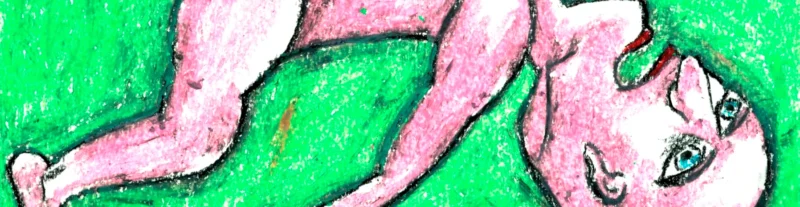
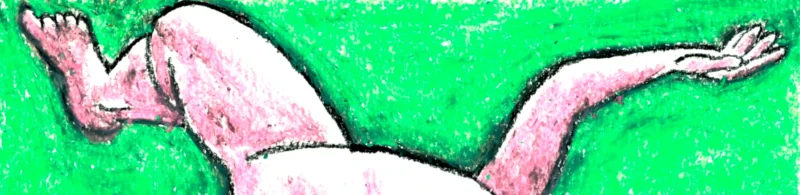
The figure is naked, isolated, stripped of narrative context or symbolic shelter. It lies against a saturated green background that offers no depth, no horizon — only a flat mental field. The posture is biomechanically unstable: asymmetrical limbs, forced torsion of the torso, an irrational distribution of weight.
This is a position that can exist only briefly, sustained by effort rather than equilibrium. Anatomically, the distortions are intentional: elongated limbs, compressed torso, oversized head. It is not caricature, but perceptual distortion. When depression becomes chronic, the body ceases to feel like a coherent whole and turns into a misaligned mechanism.
Line, Contour, and Material
The black outline enclosing the figure acts as a formal cage. It is not decorative, but restrictive. Structurally, it functions as a Gestalt boundary; emotionally, it resembles a fragile suture. It holds together what would otherwise disintegrate.
The pictorial surface is abrasive, uneven, layered. Corrections do not erase what came before; they accumulate. This visual sedimentation mirrors a ruminative mental state — thoughts revisited endlessly without resolution.
Color as Psychological Symptom
The green background carries no naturalistic meaning. It does not suggest renewal or vitality. It is perceptual saturation — flat, invasive, oppressive. A visual equivalent of anhedonia: everything is visible, nothing is alive.
The pink of the body is equally ambiguous. It is not erotic flesh, but vulnerable flesh. A desaturated, bruised pink that speaks of exposure and fatigue. Color here is not an aesthetic choice, but a symptom.
The Face and the Gaze
The face, unnaturally rotated, does not scream. The eyes are open, but they do not seek. They register. It is a gaze that is hyper-aware yet emotionally inert. I know this state well: you perceive everything, but nothing moves you anymore.
The mouth does not articulate pain. There is no outcry. It is the quiet suffering of chronic endurance — the kind that goes unnoticed because it makes no sound.
The Emotional State That Permeates the Work
Study of Balance is permeated by persistent dysphoria, emotional hypotonia, and ontological instability. There is no theatrical despair here — only slow erosion.
No catharsis is offered. No compositional resolution is reached. Balance remains suspended, unresolved, just as I remain suspended — surviving rather than living.
Why I Ask for Your Judgment
Henry, I need your perspective because I fear this work is too close to my own condition to be judged honestly. Tell me if you see in it something beyond my personal fatigue. Tell me if it speaks of our time — of a collective instability — or if it remains merely the visual record of my own failure.
Your gaze might restore the distance between private confession and public work.
Conclusion
I will end this letter with a simple truth: Study of Balance is not a formal exercise. It is a radiograph of my condition. A body that does not fall only because it keeps correcting itself, until it wears itself down.
I wish you, Henry — with all the sincerity I have left — far more luck than I have known. May your balance be less fragile. And if you lose it, may your fall be shorter, and less solitary than mine.
With weary affection,
Jean-luc
No Comments